Welcome back to the final chapter of what has somehow become a trilogy. Like some sequels, these may be more than anyone needs. Parts One and Two covered everything from the table read to the nudity arc. This one picks up on the road in Miami and brings it all home.
The Training Video and the Green Screen
Aside from Kate Ducey’s valuable contribution to the production staff, she has a great cameo in one of my favorite parts of the movie. When the sisters turn on the television at the resort, they’re greeted by an infomercial of sorts in what we called the “Training Video.” It was a blast to make. In a choreographed moment in the weight room, Katie had the task of doing leg lifts right as JP moved forward to spot Josh’s naked bench press, thereby hiding his anatomy from the lens. Admittedly, this is the one section where we did lean into the Austin Powers humor I mentioned previously and it was one of several tactics we used to set it apart from the rest of the film. Having Kristi (Susan May Pratt) appear self-conscious in front of the camera as she goes over Bear Lake’s best attributes also helped.
To simulate what a semi-professional crew might have produced, we gave her giant cue cards and placed her in front of a 20′ x 20′ green screen in the rec room at ODR. We wanted the piece to look deliberately amateur. From not pulling a perfect key off Susan’s green screen to framing shots with extra headroom, there’s a fine tonal line to walk. A big inspiration was the commercial from Ghostbusters and it’s the first thing I show people when I want to get them excited about the film.
Miami, Mostly Unplanned
When we filmed the scene with Rusty on Day 2 of principal, we hadn’t locked in the exact hometown of Leah Collins yet. We didn’t want to paint ourselves into a corner, so we ran through a bunch of potential cities in her dialogue. Initially the girls were from Chicago, which is where JP lived while writing the early drafts. While shooting Charlie’s house exteriors in Marina Del Rey on July 24, 2008, we framed shots to leave as many geographic options open as possible. When another music video sent me to Dade County in February of 2010, we decided Florida could easily sub for California because a few palm trees snuck into frame. Due to some scheduling anomalies, I had a free morning to walk around causeways and grab establishing shots that looked unmistakably Miami.

More good fortune had me practically standing in the back seat of a Mercedes Benz convertible flying down the Florida Turnpike to grab driving shots to complete the illusion that our production started in the Sunshine State. My safety was certainly in question. The driver occasionally forgot I was in a precarious position and drove a little faster than common sense would advise. The conditions were perfect with one exception: no Letus35 adaptor. Continuity wasn’t a major concern since they were all wide shots. I preferred using original footage without perfectly matched cameras over stock clips. Unfortunately, there’s a texture and diffusion that comes from the spinning ground glass of the adaptor that I miss in these shots.
Pick-ups, Re-shoots, and the Swine Flu
One of my bigger frustrations in the finished film is an early scene in front of the resort where the sisters meet Cory (Alan Cox) and Kristi for the first time. Scheduling Alan was extremely difficult — he was concurrently playing David Frost in the touring production of Frost/Nixon, and the Ahmanson Theatre is 64 miles each way from ODR. Because of this, we had to shoot the scene at two distinct times of day, and matching them would have been nearly impossible without a fleet of 18K HMIs or a massive wet-down — neither of which we had. It was one of the few moments I genuinely needed a big gun.
Because we had initially shot in March, the angle of the sun was favorable enough that I wasn’t going to put my already overworked crew through the torture of large overhead frames. That calculus changed when we returned to ODR on July 21, 2009 for four days of exterior re-shoots and pick-ups. Shooting with a 12′ x 12′ frame skinned with ½ Soft Frost helped us match the vernal footage to the harsh Southland summer sun. The grounds weren’t as lush as they’d been during the particularly rainy winter, but that was something we’d worry about in post. On one unfortunate afternoon, we almost seriously damaged our 1st AD Jaime Stocker’s car when large gust of wind almost sent the giant frame sailing into it. Not a great way to show her how appreciative we were that she offered it to haul gear close to set!

When we returned in December of 2009 with the 12′ x 12′ again we also brought more wisdom. Our cumulative time at the ranch gave us insight into knowing which parts of the ranch got windy and which didn’t. And then we came back one final time on February 18, 2010 to grab transitional cut-aways of the cabins and resort, and to finally shoot my video interview. A quick tip to filmmakers: you can never have enough interesting b-roll. I took this lesson to the extreme while shooting Lucas McNelly’s feature Up Country in Maine later that year — running around grabbing trees, leaves, signs, and hiking paths during every break eventually earned me an unexpected 2nd Unit Director credit.
The December pick-ups weren’t without their own drama. According to my calendar, I left for ODR at 9:30pm on December 2, 2009. At 9:57am the next morning, while setting up a shot, I received a panicked email and a flurry of texts from my mother: I probably had Swine Flu (H1N1) and should be feeling the effects very soon. Not only had I unknowingly exposed the entire crew and ranch, but I had a full day of work ahead and an early call time the following morning. They say the flu hits you hard and fast — that’s no joke. By late afternoon I was rapidly falling apart. The only fuel keeping me going: Theraflu and a determination to finish the movie.
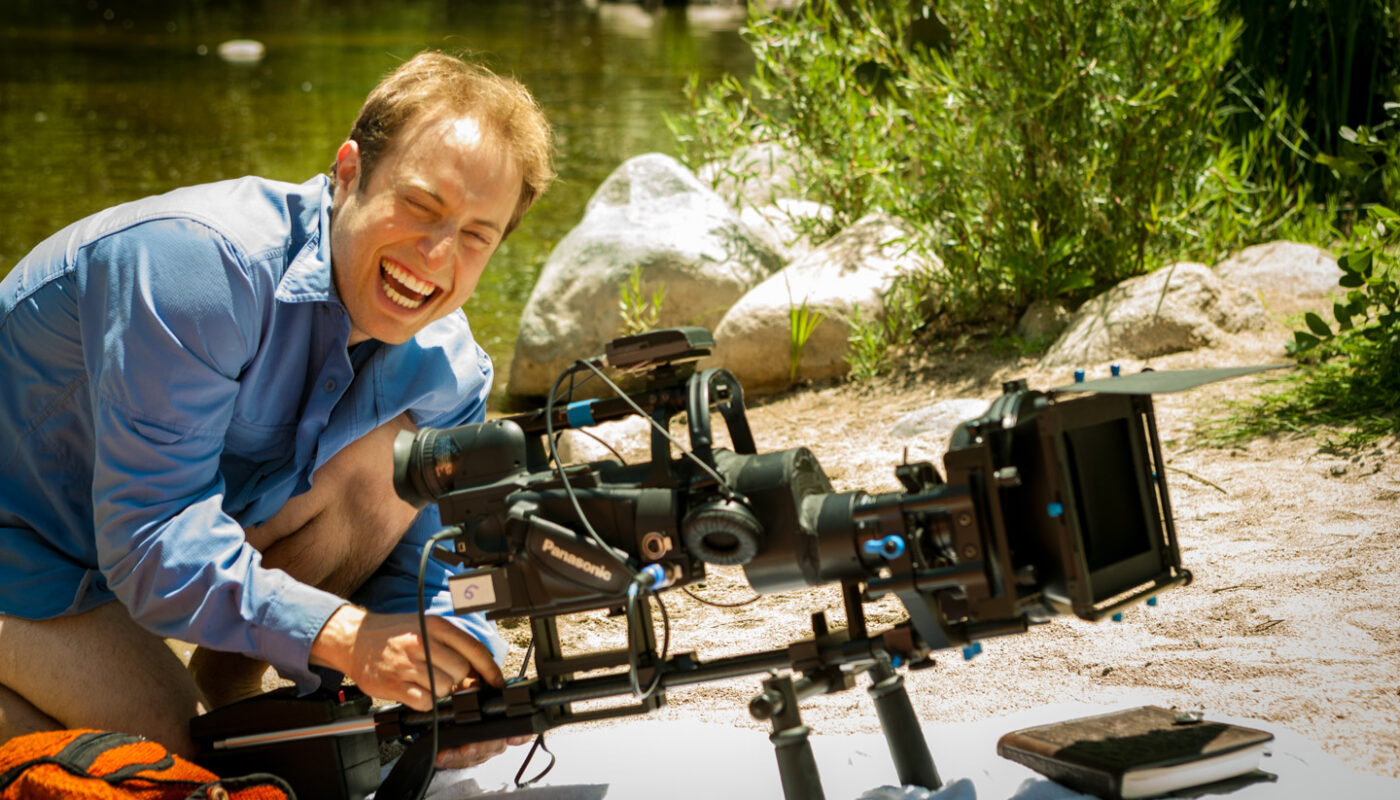
I’ll never forget how miserable I felt with the camera on my shoulder as the clock struck 9:30pm on our last shot of the night. I barely had enough strength to steady the camera before rushing up to my cabin. We had a 6am call the next morning and rolled our first shot at 7:04am. We’d left the 12′ x 12′ frame already built on stands, so all we had to do was re-skin it with China Silk and we were practically ready. We took advantage of extended magic hour thanks to the canyon’s shade, and the ambiance was so low that I could use a 2′ x 4-bank Kino as an eye light. It was a huge physical struggle, but I’m quite pleased with the revamped scene between Trevor and Leah.
Post, Audio, and Bobby’s Lawn
The unsung hero of our never-ending editorial revisions is post audio guru Maya Kuper. Generally audio is the final piece of the puzzle, but we had so many issues with our production sound that we had to get her involved earlier than usual. From blaring crickets to raucous donkeys, nature wasn’t kind to our location recording. On the human side, we dealt with planes, trains, and automobiles — and no, that’s not a cheap John Hughes reference. Maya first mixed and sweetened the audio around June of 2009 and was still tweaking it as recently as a few months ago.
Around that time, we were very excited about our cut and wanted to show it to people to secure finishing funds and distributor interest — even though it was only a first draft. That version barely resembles what we have now. In hindsight, we should’ve shown fewer people such an unpolished cut. That said, many of the notes we received were instrumental in getting the film where it is today.

Many of the best cut-aways and transitions in the finished film came from the numerous visits we made to Olive Dell Ranch over the years. Some of those trips were entirely independent of Act Naturally as Bobby Kilborn wanted us to return and shoot a reality pilot concept with our new friends at the ranch. Through creative scheduling and two cameras, we got some fantastic sunrises that our heavy production schedule had made impossible the first time around. One of our camera operators on the pilot, Jacob Conger, also managed to capture one of the most disturbing — and funniest — shots in the film. I won’t spoil it, but after you watch the movie, you’ll know. All I’ll say is that it’s sandwiched between beekeeping and bacon.
Speaking of Bobby and Becki, I have to give them a massive thank you. They were instrumental in getting the film made through their generosity and are among the kindest people I’ve ever met. They even let us take over their home so we’d have access to a kitchen (which I used every night to make vegetarian-friendly meals) and could lodge more people on site. They also rounded up golf carts to haul people and equipment at no extra charge. Bobby even makes a cameo in the film. One morning as we were blocking a small scene, he was going about his day as he normally would: mowing the lawn completely naked. I grabbed the camera and rushed over to get different angles before he finished. All we had to do was film him acting naturally.

Observing the day-to-day life at the ranch was particularly interesting for those of us who normally wear clothes. Everybody was naked full-time unless the temperatures were too frigid (and even then, the solutions were creative). Many residents would wear only a sweatshirt, leaving their privates free to declare their disdain for clothing. Some of the women would wear zip-up sweatshirts with the zipper low enough that their breasts were still exposed. You sometimes forgot that clothes must be worn when venturing off the island. It always seemed strange to see the normally-nude Becki head off fully clothed heading to Costco.
After spending so much time in that world — I never left the resort during the first two weeks of principal photography — something flipped. The clothed realm suddenly felt unnatural. When we finally left the ranch after our 17-day primary leg, I found myself regularly naked around my apartment. It just felt normal.
When you look at the number of years between our first days shooting (July 2008) and our first major public screening (March 2011), you might wonder what took so long. As I once heard on a great podcast: independents might not have much money, but they have time. There are no studio release dates rushing you through post. If it takes three years to get your film into shape, why not take them? Knowing when to walk away and declare a film finished is always difficult, but at a certain point it has to be done. Are there things I’d still change? Of course. But I’m very pleased with where the movie stands — and nobody external has tried to alter it. If a distributor or the MPAA were ever to impose notes later, then what we have right now would officially become the director’s cut.